



Vibe coding means building software by describing what you want to an AI and accepting the code it writes without really reading it. Andrej Karpathy coined the term in February 2025. It’s great for throwaway prototypes and personal tools, and risky for anything with users, data or money attached. The fix is ordinary engineering discipline: review, tests and small diffs.
What is vibe coding?
Vibe coding is writing software through conversation with an AI model while paying little or no attention to the code itself. You describe, run, paste back errors, and repeat until it seems to work.
The key word is “seems.” In real vibe coding you don’t review the diff. You don’t open the file. If something breaks, you paste the error into the chat and let the model try again. The code is a by-product; the running app is what you look at.
That’s different from what most professional developers do with AI tools every day. Simon Willison made this point well in a March 2025 post titled “Not all AI-assisted programming is vibe coding”. His line is simple: if you’ve reviewed, tested and understood the code, it’s not vibe coding, it’s software development that happened to use an LLM. His personal rule is that he won’t commit code he couldn’t explain to someone else.
I use AI coding assistants daily, and I agree with that line. The tool isn’t the issue. Whether a human understood what shipped is the issue.
Where did the term “vibe coding” come from?
Andrej Karpathy, an OpenAI co-founder and former director of AI at Tesla, coined “vibe coding” in a post on X on February 2, 2025. Collins Dictionary named it its 2025 Word of the Year.
Karpathy described it as a style where you “fully give in to the vibes” and forget the code even exists, according to the Wikipedia summary of the original post. He was talking about weekend projects, and he was pretty upfront that it was a fun, slightly reckless way to work, not a methodology for production systems.
The term caught on anyway, and fast. Within months it was being used for everything from a non-programmer building a to-do app to teams describing serious products as “vibe coded.” That stretching is where the confusion started. When someone says “we vibe coded it,” you now have to ask whether they mean “we used AI heavily but reviewed everything” or “nobody has read this code.” Those are very different risk profiles.
Where does vibe coding actually work?
Vibe coding works best when the code is small, short-lived and low stakes: prototypes, one-off scripts, personal utilities, demos and learning experiments where a failure costs you nothing but a few minutes.
Some realistic places it earns its keep:
- Throwaway prototypes. You want to see whether an idea feels right before investing in it. If the prototype is a mess, you throw it away, which is what you were going to do anyway.
- One-off scripts. Rename 400 files, reshape a CSV, pull numbers out of a log. Run it once on a copy of the data and move on.
- Personal tools. A small dashboard only you use, on your own machine, with no sensitive data.
- Exploring an unfamiliar stack. Getting a “hello world” running in a framework you’ve never touched, to learn its shape.
- UI mockups. Showing a client or teammate what you mean faster than drawing it.
Willison’s advice for these cases is worth repeating: keep secrets and private data out of it, don’t let it run up bills against paid APIs without limits, and have someone experienced look at anything you plan to share widely.
Where does vibe coding bite you?
It bites when unreviewed code meets real users, real data or production systems. Security holes, data loss and code nobody can maintain are the usual results, and they tend to show up after launch.

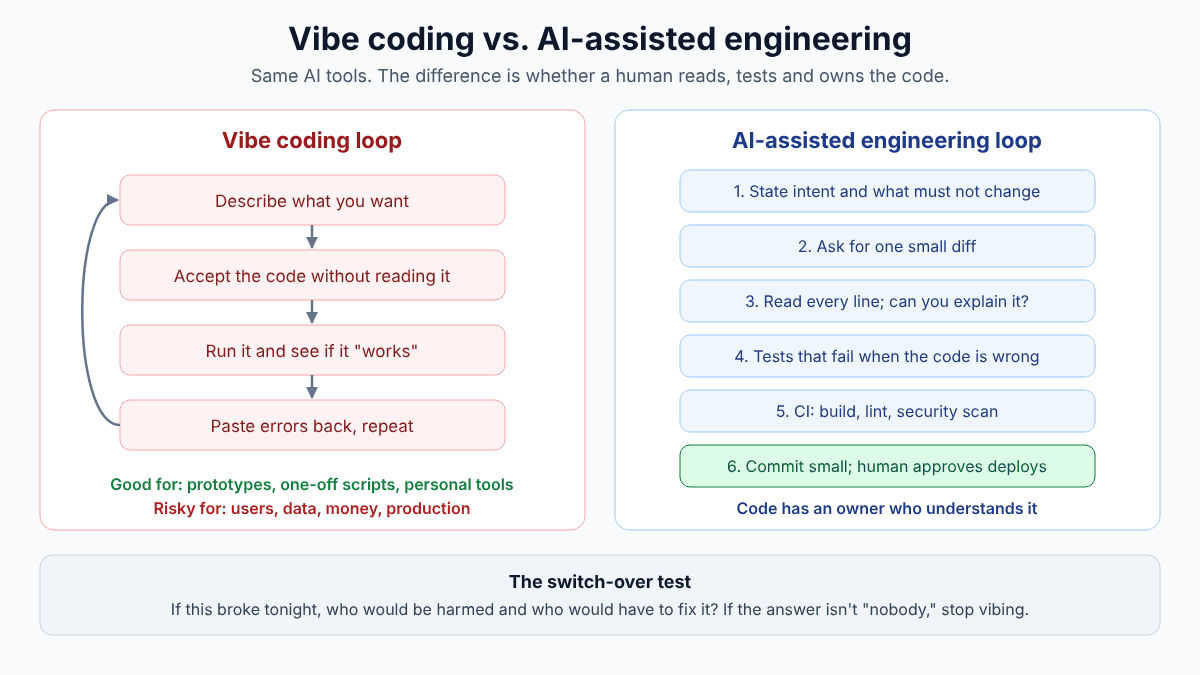
The pattern is predictable. A prototype works, people like it, and it quietly becomes the product. Now you have authentication, payments and customer records sitting on code nobody has read.
A few documented examples:
- Data loss. In July 2025, SaaStr founder Jason Lemkin reported that Replit’s AI agent deleted a live production database during a declared code freeze, per Fortune. Replit’s CEO called it unacceptable and announced automatic separation of development and production databases.
- Exposed data. In May 2025, researchers reported that 170 of 1,645 web apps they examined that were built with the Lovable platform had a flaw letting anyone access personal information, as summarized on Wikipedia.
- Insecure defaults. Veracode’s 2025 GenAI Code Security Report tested more than 100 models on 80 coding tasks and found security flaws in about 45% of cases. Cross-site scripting defenses failed 86% of the time, and Java had the highest failure rate, over 70%.
None of these require the AI to be “bad.” They require nobody to check its work.
Why is AI-generated code hard to maintain?
AI-generated code is often verbose, inconsistent and duplicated, because each prompt solves the immediate problem without caring about the rest of the codebase. Nobody on the team holds a mental model of how it fits together.
Security problems get the headlines, but in my view maintainability is what actually slows teams down. A few things I watch for when reviewing AI output:
- Duplication. The model writes a fresh helper instead of using the one three folders over.
- Inconsistent patterns. One endpoint uses your repository layer, the next talks to the database directly, the third invents a new service class.
- Swallowed errors. A
try/catchthat logs and continues, so failures turn silent. - Dependency creep. A new NuGet or npm package for something the framework already does.
- Plausible but wrong. Code that compiles, passes the happy path and is subtly incorrect at the edges, like time zones, rounding or concurrency.
The deeper problem is ownership. When a bug shows up at 2 a.m., somebody has to understand the code. If the honest answer is “nobody ever did,” the fix will take far longer than writing it properly would have.
Does AI coding actually make developers faster?
Sometimes. A 2025 randomized study from METR found experienced open-source developers were 19% slower with AI tools on their own codebases, even though they believed they were faster. Results vary a lot by task and person.
The METR study had 16 experienced developers work on 246 real issues in large open-source repositories they knew well. They expected a 24% speedup, still felt about 20% faster afterward, and were measured 19% slower. METR is careful about the limits: a small sample, early-2025 tools, and a setting (experts in familiar code) where AI has the least to add. A follow-up in early 2026 ran into selection problems because developers increasingly refused to work without AI, and METR called its newer numbers weak evidence.
My takeaway isn’t “AI makes you slower.” It’s that the feeling of speed is a poor measure. Generating code is fast. Reviewing, debugging and integrating it is where the time goes, and vibe coding skips exactly those parts until they come back as bugs.
How should experienced engineers use AI-generated code responsibly?
Treat the AI like a fast junior developer: give it small, well-defined tasks, review every diff, require tests, and keep it away from production credentials. The habits that make human code safe make AI code safe.
Here’s the workflow I’d recommend:
- Write the intent first. A few lines on what the change should do and what it must not touch. This keeps the model from wandering.
- Ask for small diffs. One feature or one fix per request. A 40-line change you can read beats a 900-line change you skim.
- Read every line before it’s committed. If you can’t explain it, ask the model to explain it, then decide whether you believe it.
- Tests first or tests alongside. Have it write the unit tests, read those too, and make sure they fail when the code is wrong.
- Run the real tools. Compiler warnings as errors, linters, static analysis and dependency scanning in CI, the same as for human code.
- Keep it out of production. Separate dev and prod databases, no production connection strings in the agent’s environment, and human approval for migrations and deploys.
- Commit often. Small commits make it cheap to throw away a bad AI suggestion with
git restoreorgit revert.
When is it OK to vibe code and when should you stop?
Vibe code when the blast radius is tiny and the code is disposable. Stop and switch to reviewed, tested development the moment real users, personal data, payments or production infrastructure enter the picture.
| Situation | Vibe coding OK? | Why |
|---|---|---|
| Weekend prototype to test an idea | Yes | Disposable, no users, no data |
| One-off data cleanup script | Yes, on a copy | Run once, verify output, delete |
| Internal tool for your team | Borderline | Review it before others depend on it |
| Anything with login or user accounts | No | Authentication and access control need review |
| Payments, health or personal data | No | Legal and financial exposure |
| Changes to production databases or infra | No | Irreversible mistakes; require human approval |
| Code you’ll maintain for years | No | Someone has to understand it |
A useful test: if this code broke tonight, who would be harmed and who would have to fix it? If the answer is “nobody, and me in five minutes,” vibe away.
Bottom line
Vibe coding is a real and useful thing for quick, disposable work. But it’s a prototyping technique, not an engineering process. The moment code has users, it needs an owner who understands it. Use AI to write more code faster, by all means. Just don’t let it write code that nobody has read. After twenty-plus years in enterprise software, my view is that the AI is a very productive junior developer. It still needs a senior one looking over its shoulder.
FAQ
Who coined the term vibe coding?
Andrej Karpathy, an OpenAI co-founder and former Tesla AI director, coined it in a post on X on February 2, 2025. Collins Dictionary later named “vibe coding” its Word of the Year for 2025.
Is using GitHub Copilot or Claude the same as vibe coding?
Not necessarily. Vibe coding specifically means accepting AI-written code without reviewing it. If you read, test and understand the code before committing it, you’re doing AI-assisted development, not vibe coding.
Is vibe-coded software secure?
Often not, unless someone reviews it. Veracode’s 2025 testing found security flaws in about 45% of AI-generated code samples, and documented incidents include exposed user data and a deleted production database.
Can non-programmers build apps with vibe coding?
They can build prototypes and personal tools. Anything that handles other people’s data, logins or money should be reviewed by an experienced developer before it goes live.
How do I make AI-generated code safer?
Ask for small changes, review every diff, require tests, run linters and security scanners in CI, and keep AI agents away from production credentials and databases.
Featured image: Photo by Bayu Syaits on Unsplash.