
ASP.NET Core vs Spring Boot in 2026: An Honest Comparison
ASP.NET Core and Spring Boot are both mature, fast, free, cross-platform frameworks for building web APIs and services in 2026. ASP.NET Core usually wins on raw throughput, tooling simplicity, and long-term support. Spring Boot wins on ecosystem breadth and the size of the Java talent pool. For most teams, the language the team already knows should decide it.
I’ve spent more than 20 years building enterprise software in both C# and Java, and these days I run my own products on .NET. I’ve tried to keep this comparison fair and practical. It covers performance, ecosystem, hosting, support cycles, hiring, and learning curve, with a summary table and a simple way to decide.
What are ASP.NET Core and Spring Boot in 2026?
ASP.NET Core is Microsoft’s open-source web framework for .NET, currently on .NET 10 LTS. Spring Boot is the opinionated, auto-configured way to build Spring applications on the JVM, currently on the 4.x line.
ASP.NET Core ships as part of .NET. The current LTS, .NET 10, came out in November 2025 and is supported until November 2028. You get minimal APIs, MVC controllers, Razor Pages, Blazor, SignalR, gRPC, Identity, and EF Core as the usual data layer, all from one vendor and one SDK.
Spring Boot sits on top of the Spring Framework. Spring Boot 4.0 arrived in November 2025 with Spring Framework 7. It keeps a Java 17 baseline, moves to Jakarta EE 11, and fully supports JDK 25. Spring Boot 4.1 followed in mid-2026. You usually pair it with Spring Data JPA (Hibernate), Spring Security, and whatever else the Spring ecosystem provides for the job, which is a lot.
Here’s the same endpoint in each, to set the tone:
// ASP.NET Core minimal API
var app = WebApplication.CreateBuilder(args).Build();
app.MapGet("/hello/{name}", (string name) => new { Message = $"Hello, {name}" });
app.Run();
// Spring Boot
@SpringBootApplication
@RestController
public class DemoApplication {
public static void main(String[] args) {
SpringApplication.run(DemoApplication.class, args);
}
@GetMapping("/hello/{name}")
public Map<String, String> hello(@PathVariable String name) {
return Map.of("message", "Hello, " + name);
}
}How do ASP.NET Core and Spring Boot compare at a glance?
They’re close on capability. The real differences are in support cycles, tooling, hosting habits, and the ecosystems that come with each language.
| Factor | ASP.NET Core | Spring Boot |
|---|---|---|
| Language | C# (also F#) | Java (also Kotlin) |
| Current version (Oct 2026) | .NET 10 LTS, C# 14 | Spring Boot 4.1 on JDK 17+ (JDK 25 LTS recommended) |
| License | MIT (open source) | Apache 2.0 (open source) |
| Free support window | 3 years per LTS release | 13 months per minor release (OSS) |
| Raw throughput | Among the fastest in TechEmpower tests | Good, rarely the bottleneck in real apps |
| Startup and footprint | Fast, with Native AOT for small images | Slower JVM start, improved with AOT cache or GraalVM native |
| Build tooling | One dotnet CLI and SDK |
Maven or Gradle, plus a JDK you choose |
| Data access | EF Core, Dapper | Spring Data JPA / Hibernate, jOOQ, JDBC |
| Typical hosting | Linux containers, Azure, IIS on Windows | Linux containers, Kubernetes, any cloud |
| Ecosystem strength | Cohesive first-party stack | Huge, mature open-source ecosystem |
Which is faster, ASP.NET Core or Spring Boot?
In synthetic benchmarks, ASP.NET Core is faster. Microsoft cites TechEmpower Round 23 numbers far ahead of Java servlets. In real business apps, the database and your own code usually matter more than the framework.
Microsoft’s ASP.NET Core page claims that in TechEmpower’s JSON test, ASP.NET Core minimal APIs handled 2.05 million responses per second, compared with 328K for Java Servlet and 224K for Node.js. Those are real benchmark results, but keep in mind that a JSON serialization microbenchmark measures the framework’s best case with nothing else going on.
In my experience, the typical enterprise endpoint spends most of its time waiting on SQL Server, Oracle, or another service. A badly indexed query costs more than any framework choice. Where the difference does show up:
- High-volume APIs and gateways, where framework overhead per request adds up and ASP.NET Core’s efficiency means fewer servers.
- Startup and scale-to-zero. .NET starts quickly and Native AOT makes it smaller still. On the Java side, JDK 25’s AOT cache and GraalVM native images have narrowed the gap considerably, but a traditional Spring Boot app on a plain JVM still takes longer to warm up.
- Concurrency model. .NET has had
async/awaiteverywhere for years. Java now has virtual threads (final since JDK 21), and Spring Boot can turn them on withspring.threads.virtual.enabled=true, so you can write simple blocking code that still scales. Both models work well in 2026.
How do the ecosystems and libraries compare?
Spring’s ecosystem is broader, especially for messaging, data, and enterprise integration. .NET’s is more cohesive, because Microsoft ships most of what a web app needs as one supported, versioned set.
Spring’s strength is that someone has already solved your problem: Spring Security, Spring Data for nearly every database, Spring Batch, Spring Integration, Spring Cloud, and first-class clients for Kafka and almost every message broker. If your company’s world revolves around the JVM data stack, Spring fits right in.
.NET goes the other way. ASP.NET Core, EF Core, Identity, logging, configuration, dependency injection, health checks, OpenAPI, and the test platform all come from Microsoft and ship together. When I upgrade a .NET app, I bump one major version and the pieces still fit. In a Spring app the Spring Boot BOM handles that well, but you still have more independent projects to keep track of.
Spring Boot 4 also brought its share of upgrade work. The framework was split into smaller modules, Jackson 3 changes package names, and JSpecify null-safety annotations arrived. Dan Vega’s overview is a good summary of what changed. None of it is bad, but a 3.x to 4.x upgrade is real work.
How do hosting and deployment differ?
Both run well in Linux containers on any cloud. ASP.NET Core also runs natively on Windows with IIS, which suits Microsoft shops. Spring Boot is most at home as a container or executable JAR on Linux.
This is where my own setup biases me, and I’ll say so plainly. I run around 20 sites and several ASP.NET Core apps on one Windows Server VPS with IIS and SQL Server. ASP.NET Core slots into that easily: install the Hosting Bundle, create an app pool, deploy. You can run Spring Boot on Windows, as a JAR wrapped in a Windows service behind IIS as a reverse proxy, but you’re doing it the less common way.
In containers the difference mostly disappears. Both produce an image, both expose health endpoints for Kubernetes (ASP.NET Core health checks, Spring Boot Actuator), and both export OpenTelemetry metrics and traces. .NET can build container images straight from the SDK with no Dockerfile. Spring Boot does the same with Buildpacks through its Maven and Gradle plugins.
One cost difference worth knowing on the Java side: the JDK itself is a separate choice. OpenJDK builds such as Eclipse Temurin are free, but Oracle JDK licensing has fine print, and Oracle JDK 21’s free updates moved to the paid OTN license in October 2026. With .NET, the runtime is simply free.
What about support cycles and upgrades?
.NET gives you three years of free support per LTS release. Spring Boot gives each minor version 13 months of open-source support, so staying supported means upgrading roughly once a year.
According to Spring’s support schedule as summarized by Dan Vega, Spring Boot 4.0’s OSS support ends in December 2026 and 4.1’s in July 2027, and every 3.x branch is already out of OSS support. Paid extended support exists if you need longer. On top of that you track the JDK separately.
On .NET, you can sit on 10 LTS until November 2028 and take the monthly patches. In practice that means fewer upgrade projects. Neither cadence is hard if you upgrade continuously, but if your organization tends to let things drift, .NET’s longer window is more forgiving. Spring’s cadence is better than it sounds in one way, though: minor-version upgrades are usually small, as long as you don’t skip several of them.
Which is easier to learn and to hire for?
ASP.NET Core is easier to start with: one SDK, a minimal API in a few lines, and excellent IDE support. Spring Boot takes longer to really understand. Hiring depends mostly on your local market and industry.
A new developer can be productive in ASP.NET Core quickly. dotnet new webapi, open it in Visual Studio, Rider, or VS Code, and you’re running. Spring Boot is easy to start too (Spring Initializr is excellent), but understanding why it works means learning auto-configuration, bean lifecycles, proxies, and annotation-driven behavior. When something goes wrong in Spring, the cause is often in configuration you never wrote. Seasoned Spring developers are very productive. New ones sometimes find it opaque.
On hiring, I won’t quote statistics that vary widely by country and industry. Broadly speaking, Java tends to be strongest in banking, insurance, telecom, and big back-office systems, while C# is common in Microsoft-centric companies and internal line-of-business apps. Both talent pools are large. Look at your local job boards. That will tell you more than any global survey.
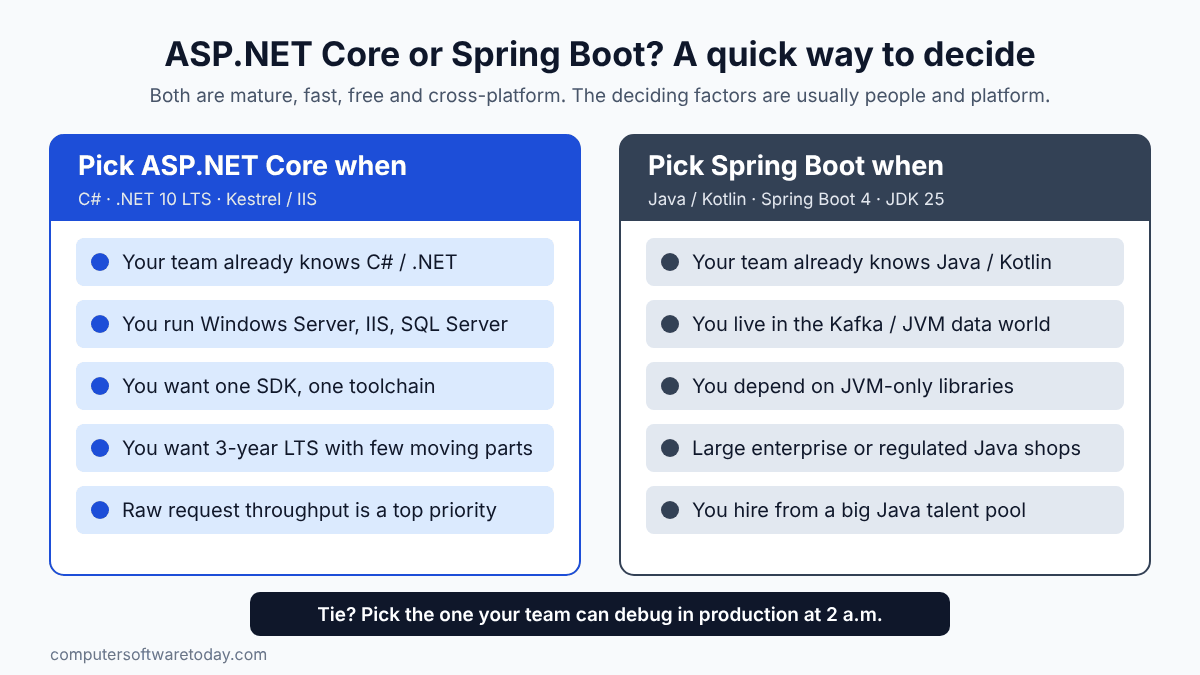
When should you pick ASP.NET Core vs Spring Boot?
Pick ASP.NET Core for Microsoft-centric shops, Windows hosting, high-throughput APIs, or a small team that wants one toolchain. Pick Spring Boot for JVM-heavy organizations, Kafka and data-platform work, or teams with deep Java experience.
Choose ASP.NET Core if:
- Your team writes C#, or your systems already run on Windows Server, IIS, SQL Server, or Azure.
- You’re a small team or a solo developer and want fewer moving parts. That’s my situation, and it’s why I build on .NET.
- Throughput per server or startup time directly affects your hosting bill.
- You’d rather upgrade every two or three years than every year.
Choose Spring Boot if:
- Your team and codebase are Java or Kotlin. Rewriting working systems to change frameworks is almost never worth it.
- You’re building in a JVM ecosystem: Kafka, Spark, Flink, or existing Java libraries you can’t replace.
- Your organization already has Spring standards, shared starters, and people who know how to operate it.
If it’s genuinely a tie, pick the one your team can debug in production at 2 a.m. That matters more than any benchmark.
Bottom line
There’s no wrong answer here, only a wrong fit. ASP.NET Core in 2026 is the faster, tidier, longer-supported option, and it’s what I’d choose for a new product, especially for a small team or a Windows shop. Spring Boot is still the safer bet in large Java organizations, with an ecosystem that’s hard to match and a huge pool of experienced developers. Having worked in both, my view is that projects rarely go badly because of the framework. They go badly when a team is fighting a stack it doesn’t know. Choose the one your people can build, run, and fix with confidence.
FAQ
Is ASP.NET Core faster than Spring Boot?
In synthetic benchmarks such as TechEmpower, yes, often by a wide margin. In typical database-backed business apps, the gap is much smaller, because queries and I/O dominate response time.
Which has longer support, .NET or Spring Boot?
.NET LTS releases get three years of free support, and .NET 10 runs until November 2028. Each Spring Boot minor version gets 13 months of open-source support, with paid extended support available.
Can Spring Boot run on Windows and IIS?
Yes. A Spring Boot JAR runs on Windows, and you can put IIS in front of it as a reverse proxy. It’s less common than Linux or container hosting, though.
Is ASP.NET Core free for commercial use?
Yes. .NET and ASP.NET Core are open source under the MIT license and free for commercial use, with no runtime licensing to worry about.
Which is easier for beginners?
ASP.NET Core is usually easier at first, with one SDK and minimal APIs. Spring Boot is easy to start, but its auto-configuration takes longer to understand.
Should I migrate from Spring Boot to ASP.NET Core?
Rarely. A working Spring Boot system with a skilled Java team should stay on Spring. Consider .NET for new products, or when your team and platform are already Microsoft-centric.
Featured image: Photo by Mohammad Rahmani on Unsplash.
About The Author

