
How Google AI Overviews and ChatGPT Search Choose Sources to Cite
Google AI Overviews cite pages that are indexed, eligible for a search snippet, and relevant to the question or to related sub-queries Google runs behind the scenes. ChatGPT search cites pages its OAI-SearchBot crawler can reach through its search providers. Neither publishes a formula, but crawl access, clear structure, fresh content and real expertise all improve your odds.
How do Google AI Overviews choose which websites to cite?
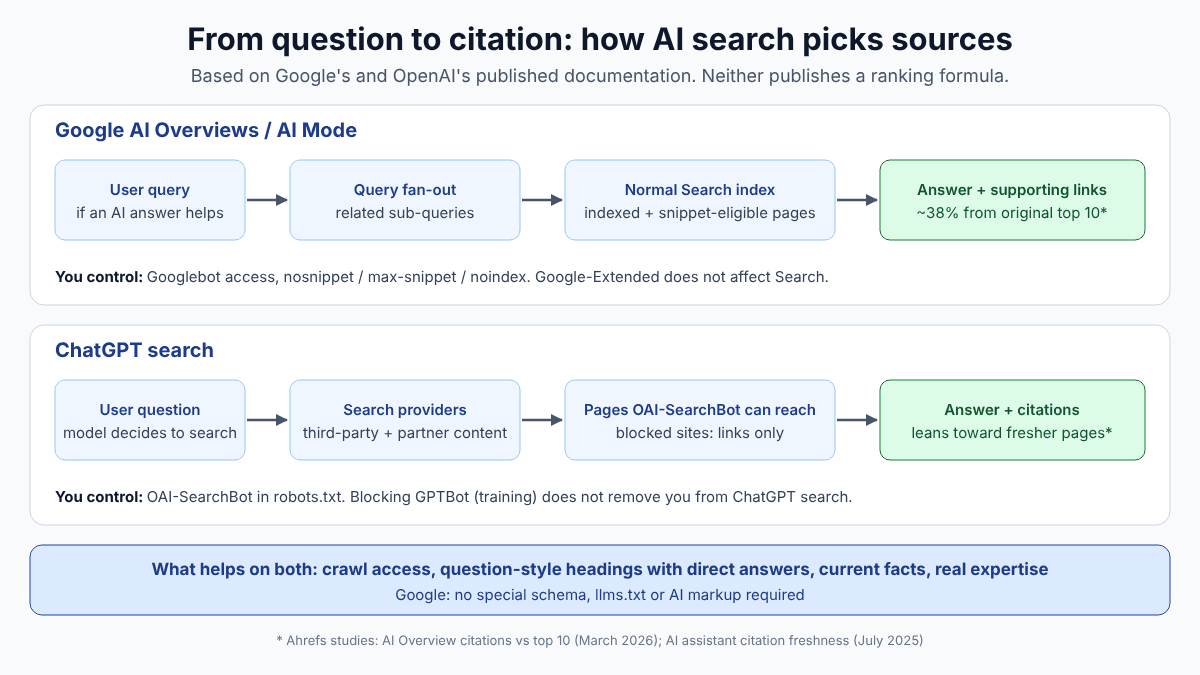
Google says AI Overviews and AI Mode draw from its normal Search index, using “query fan-out” to run several related searches and then citing pages that support the generated answer. There is no separate AI index to submit to.
Google’s own page, AI features and your website, is the most authoritative source we have, and it’s refreshingly blunt. To appear as a supporting link, a page has to be indexed and eligible to be shown in Search with a snippet. Google says there are no additional technical requirements and no special optimizations needed.
The interesting part is query fan-out. Instead of answering only the exact question typed, the system may break it into subtopics, search for each one, and gather supporting pages as it writes the response. That’s why AI Overviews often link to a wider set of pages than the classic ten blue links, and why a page can be cited for a query it doesn’t rank well for.
Google also notes that AI Overviews and AI Mode may use different models, so they won’t always cite the same pages, and that AI Overviews only show up when Google’s systems think they’ll help. Plenty of queries never trigger one.
Do you need to rank in the top 10 to be cited?
Not anymore, according to recent data. An Ahrefs study published in March 2026 found only about 38% of AI Overview citations also ranked in the top 10 results for the original query.
That Ahrefs analysis looked at roughly 863,000 keyword results pages and about 4 million cited URLs. It found 37.9% of cited URLs appeared in the top 10, another 31.2% ranked somewhere in positions 11 to 100, and 31% didn’t appear in the top 100 for that query at all. The same team’s earlier study, from July 2025, had found about 76% of citations coming from the original results page.
The authors’ explanation lines up with Google’s documentation: fan-out sub-queries pull in pages that rank for related questions. So the practical lesson isn’t “rankings don’t matter.” It’s that ranking for the cluster of questions around a topic matters, not just the head keyword.
That’s a good argument for H2 headings phrased as the actual questions people ask. Each section then stands a chance of being the best answer to one of those sub-queries.
How does ChatGPT search choose which sources to cite?
ChatGPT search uses third-party search providers plus content from partners, and it decides when to search based on the question. To be included, your site must allow OpenAI’s OAI-SearchBot crawler.
OpenAI’s launch post for ChatGPT search (October 2024) says it relies on third-party search providers and content that partners supply directly, and that any website or publisher can choose to appear. It doesn’t publish a ranking formula, so anyone claiming to know exactly how ChatGPT ranks sources is guessing.
What OpenAI does document is crawl access. Its crawler overview says OAI-SearchBot is the bot that surfaces websites in ChatGPT search, and sites that block it won’t appear in search answers, though they may still show up as plain navigational links. It’s separate from GPTBot, which collects training data. You can block GPTBot and still allow OAI-SearchBot. OpenAI says robots.txt changes take roughly 24 hours to be reflected in search.
There’s also ChatGPT-User, which fetches a page when a user asks ChatGPT to look at it. OpenAI says robots.txt rules may not apply to those user-initiated visits.
Does content freshness affect AI citations?
For AI assistants, yes, modestly. Ahrefs found ChatGPT, Perplexity, Gemini and Copilot cite content about 25.7% fresher on average than Google’s organic results, while Google AI Overviews showed no freshness preference.
The Ahrefs freshness study (July 2025, about 17 million citations) found ChatGPT had the strongest lean toward newer pages. Google AI Overviews were the outlier, citing content slightly older than the organic results on average.
Before you rush to change every “last updated” date, note the caveats. The average cited page was still almost three years old. And Google’s John Mueller has warned against bumping dates without real changes. What this tells me is simple: keep pages on fast-moving topics genuinely current. When a version number, price or feature changes, update the article and say so. That’s good for readers whether or not an AI is watching.
Does E-E-A-T matter for AI Overviews?
Indirectly, yes. AI Overviews are built from Google Search results, and Google’s ranking systems reward content showing experience, expertise, authoritativeness and trust, especially on health, money and safety topics.
Google’s guide to creating helpful, reliable, people-first content says E-E-A-T itself isn’t a specific ranking factor, but its systems use a mix of signals that identify content with good E-E-A-T, and trust is the most important part. It suggests asking “Who, How and Why” about your content:
- Who made it? Real bylines linked to a real author page. Google specifically calls out fabricated author profiles as deceptive.
- How was it made? If automation or AI substantially generated it, readers should be told where they’d reasonably wonder.
- Why does it exist? Primarily to help people, not to attract search traffic.
For a small technical site, the “experience” part is your edge. Commands you’ve actually run, screenshots from your own server, the error message you hit and how you fixed it. A big content farm can’t fake that well, and it’s exactly what makes a page worth citing.
Does schema markup help you get cited by AI?
Google says no special schema is required for AI Overviews or AI Mode. Structured data still helps Google understand pages and earn rich results, but it must match the visible text on the page.
This one surprises people because a lot of “AI SEO” advice leads with schema. Google’s AI features page states plainly that you don’t need new machine-readable files, AI text files or special structured data to appear. Its recommendation is to keep any structured data consistent with what’s visible on the page.
My take: use the schema types that fit your content anyway, such as Article with a proper author and dates, BreadcrumbList, and Product or LocalBusiness where relevant. It’s cheap and it helps classic search features. Just don’t expect a FAQPage block to be a magic citation ticket. Google stopped showing FAQ rich results entirely in May 2026, after restricting them to government and health sites in 2023. Clean, well-organized visible text is what the AI systems read.
What practical steps help a site get cited by AI search?
Make sure the right crawlers can reach you, structure pages so each section answers a specific question, keep facts current, show real expertise, and measure the results in Search Console and your analytics.
Here’s the checklist I’d work through:
- Check crawl access. Googlebot and Bingbot must be allowed. If you want ChatGPT search citations, allow OAI-SearchBot; for Perplexity, PerplexityBot; for Claude’s search, Claude-SearchBot. Also check your CDN or firewall isn’t silently blocking them.
- Stay snippet-eligible. Avoid
nosnippetor a tinymax-snippeton pages you want cited. Those controls do limit what Google can show. - Lead with the answer. A short, direct summary at the top, then detail. Each H2 should be a question with a one- or two-sentence answer right under it.
- Use tables and numbered steps where they fit. They’re easy for both readers and machines to extract.
- Cite your own sources. Link to official docs and primary data. It helps readers trust you, and it shows where your facts came from.
- Keep important content in text, not baked into images or hidden behind scripts that may not render for every crawler.
- Update fast-moving pages when facts change, and only then change the date.
- Build topic depth with internal links between related articles, so you rank for the cluster of sub-questions, not just one keyword.
| Platform | Crawler to allow | Opt-out that doesn’t remove you from answers |
|---|---|---|
| Google AI Overviews / AI Mode | Googlebot | Google-Extended (Gemini training and grounding; not Search) |
| ChatGPT search | OAI-SearchBot | GPTBot (training) |
| Perplexity | PerplexityBot | None needed; Perplexity says it doesn’t train on crawled content |
| Claude | Claude-SearchBot | ClaudeBot (training) |
How do you measure traffic from AI Overviews and ChatGPT?
Google includes AI Overview and AI Mode traffic in the Search Console Performance report under the “Web” search type, without a separate filter. ChatGPT and other assistants show up as referrals in your analytics.
That means you can’t isolate AI Overview clicks in Search Console today. You’ll see them blended into normal web search. For ChatGPT, Perplexity, Copilot and Gemini, check your analytics referral report for their domains and for a utm_source=chatgpt.com tag. Don’t trust those numbers completely: in October 2026 analysts reported ChatGPT clicks arriving with no referrer or UTM tag, showing up as Direct traffic instead. OpenAI hadn’t commented, so it may be a bug, but it’s a reminder that AI referral numbers are a floor, not a total.
Set expectations accordingly. Pew Research found that people who saw an AI summary on Google clicked a regular result in 8% of visits, versus 15% without one, and clicked a link inside the summary only about 1% of the time, as The Register reported. Google disputed the methodology. Either way, being cited is partly a branding win: your name is in the answer even when nobody clicks.
Bottom line
If you were hoping for a secret formula for AI citations, there isn’t one. What does exist is less exciting and more useful: the boring fundamentals still work. Let the crawlers in, write pages that answer real questions directly, keep facts current, show that a real person with real experience wrote them, and cite your sources. Google says outright that there’s no special AI optimization, and OpenAI doesn’t publish a ranking formula. Anyone selling a shortcut is guessing. The one change I’d make if you haven’t already is structural: question-style headings with short, direct answers underneath. That helps readers, classic search and AI systems alike.
FAQ
Can I submit my site to Google AI Overviews?
No. There’s no submission process. Google pulls AI Overview citations from its normal Search index, so a page only needs to be indexed and eligible to show a snippet.
Does blocking Google-Extended remove me from AI Overviews?
No. Google-Extended controls use of your content for Gemini model training and grounding in other Google products. AI Overviews are a Search feature controlled by Googlebot and snippet settings like nosnippet.
Does blocking GPTBot keep me out of ChatGPT search?
No. GPTBot is OpenAI’s training crawler. ChatGPT search inclusion depends on OAI-SearchBot, so you can block GPTBot and still be cited in ChatGPT answers.
Do I need an llms.txt file to be cited by AI?
Not for Google. Google’s documentation says you don’t need new machine-readable files, AI text files or special markup to appear in AI Overviews or AI Mode.
Does updating my content help AI citations?
Genuine updates can help with AI assistants; Ahrefs found ChatGPT and others cite fresher pages than Google’s organic results on average. Changing the date without changing the content isn’t recommended.
Featured image: Photo by MJ Duford on Unsplash.
About The Author

